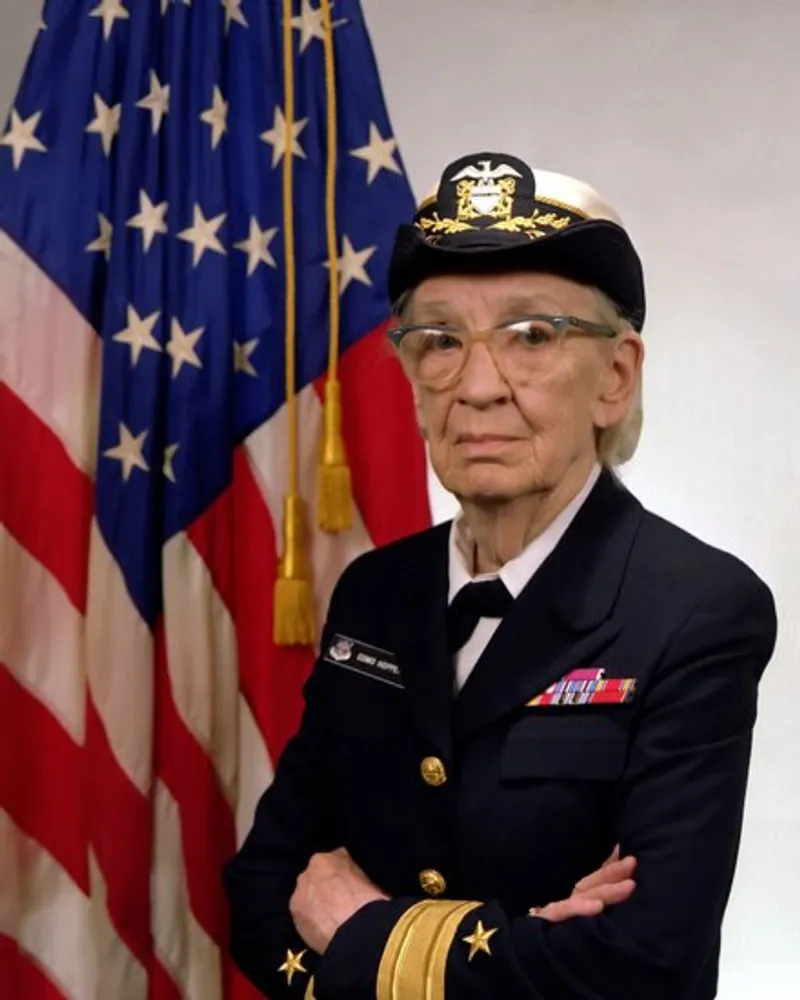
Grace Brewster Murray Hopper (1906–1992) was an American computer scientist, mathematician, and United States Navy rear admiral. She was a pioneer in computer programming who invented the first compiler and was instrumental in developing COBOL, one of the earliest high-level programming languages. Known as “Amazing Grace” and “Grandma COBOL,” she transformed programming from an arcane specialty into an accessible discipline.
Early Life and Education
Born in New York City, Hopper showed early curiosity about how things worked—at age seven, she dismantled alarm clocks to understand their mechanisms. She excelled academically, graduating Phi Beta Kappa from Vassar College in 1928 with degrees in mathematics and physics.
Hopper earned her Ph.D. in mathematics from Yale in 1934, becoming the first woman to achieve this distinction at Yale[1]. She taught mathematics at Vassar before the war changed everything.
Navy Service and the Mark I
In 1943, during World War II, Hopper joined the U.S. Navy Reserve. She was assigned to the Bureau of Ships Computation Project at Harvard, where she became one of the first programmers of the Harvard Mark I computer[2].
The Mark I was a room-sized electromechanical calculator. Hopper and her colleagues programmed it by punching instructions onto paper tape. She wrote the 561-page manual explaining its operation—one of the first programming manuals ever created.
The First Compiler (1952)
After the war, Hopper joined the Eckert-Mauchly Computer Corporation, working on the UNIVAC I. There she conceived her most revolutionary idea: a program that could translate mathematical notation into machine code.
When she proposed this “compiler,” colleagues said it was impossible—computers could only do arithmetic, not process programs. Hopper persisted, and in 1952, she demonstrated the A-0 System, the world’s first compiler[3].
From FLOW-MATIC to COBOL
Hopper believed programming should use English words, not cryptic symbols. She developed FLOW-MATIC (1955-1959), one of the first programming languages to use English-like syntax.
This work directly influenced COBOL, developed by the CODASYL consortium in 1959. Hopper was instrumental in COBOL’s design and spent years promoting its adoption. Today, COBOL still processes an estimated 95% of ATM transactions worldwide[4].
”It’s Easier to Ask Forgiveness Than Permission”
Hopper was famous for her colorful personality and memorable sayings. Her philosophy of innovation—“It’s easier to ask forgiveness than permission”—captured her approach to breaking through bureaucratic resistance.
She also popularized the term “debugging” after a moth was found causing problems in the Mark II computer, though she noted the term predated this incident.
Legacy
Hopper retired from the Navy in 1986 at age 79 as a rear admiral—the oldest serving officer at the time. She received the National Medal of Technology in 1991 and the Presidential Medal of Freedom posthumously in 2016.
Her legacy extends far beyond any single invention. By proving that computers could help write programs and that programming could use human language, Hopper made software development accessible to millions who followed.
Sources
- Yale University. “Biography of Grace Murray Hopper.” Details of Hopper’s education and achievements.
- Computer History Museum. “Grace Hopper.” Timeline of Hopper’s work on the Mark I.
- Wikipedia. “A-0 System.” Technical history of the first compiler.
- Reuters. “Wanted urgently: People who know a half century-old computer language.” Statistics on COBOL’s continued critical role in finance.